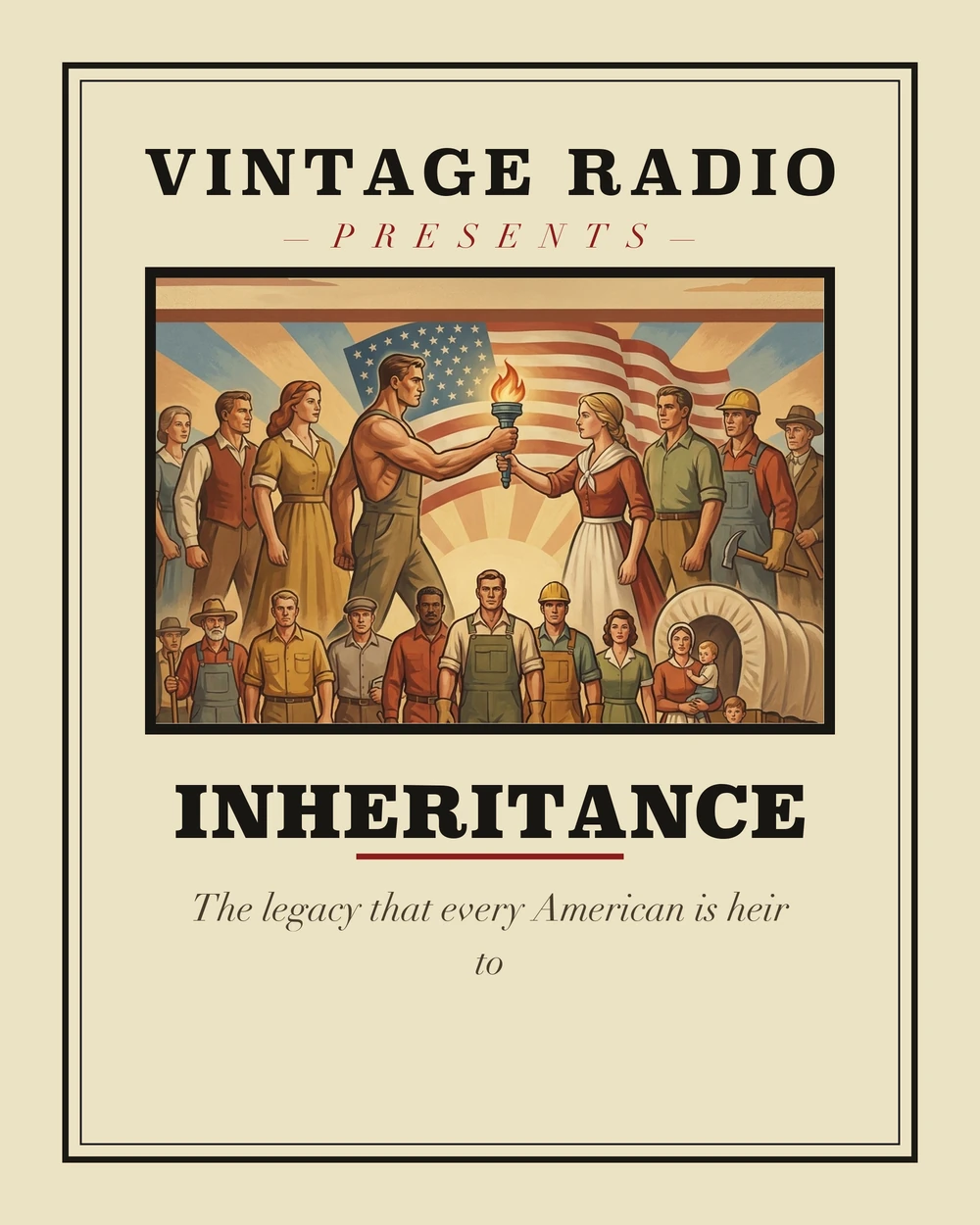
Inheritance
America's Story, Told as Drama
The title Inheritance had nothing to do with family estates or contested wills. The word carried a larger meaning for the show's producers: the sum of American history itself — the figures, events, and struggles that shaped the country and belonged, in some sense, to every citizen. That framing gave the series its identity. Each episode dramatized a piece of that shared legacy, from Dorothea Dix's campaign for humane treatment of the mentally ill in the 1840s to the ratification of the 19th Amendment to the westward push of Lewis and Clark. The show ran on NBC radio from April 18, 1954 to April 24, 1955, producing fifty known episodes across its single season.
It was a joint production between NBC and the American Legion and its Auxiliary — a partnership that placed the series firmly in the tradition of patriotic broadcasting that had found a ready audience in the postwar decade. The American Legion contributed brief post-script messages delivered by Legion functionaries at the close of episodes, a format the show borrowed from the Ladies Auxiliary to the Veterans of Foreign Wars-sponsored American Trail series of the year before. The result was a program that blended dramatic storytelling with a civic sense of purpose.
The People Behind It
Producer and director Albert McCleery brought real credentials to the project. An NBC figure known for his interest in theatrical innovation, McCleery went on to create the Cameo Theatre and NBC Matinee Theater for television — but in 1954 he was applying that same instinct for dramatic presentation to radio. His handling of the series gave it a polished, purposeful feel that matched the ambition of its subject matter.
The writing staff was notably accomplished. Ernest Kinoy, Karl Swenson, and George Lefferts all contributed scripts, and all three had significant ties to NBC's science-fiction radio anthologies Dimension X and X Minus One. Swenson in particular wore two hats on Inheritance — he wrote at least the "Nancy Hanks" installment, and he was also one of Golden Age radio's most in-demand character actors, so his presence as a performer seems likely. Lefferts and Kinoy brought the same craft they'd applied to speculative fiction to the demands of historical drama.
Music came from Robert Armbruster, a veteran NBC composer and conductor who had led the NBC Hollywood Orchestra and worked on Cavalcade of America and The Great Gildersleeve. His experience with prestige broadcasting translated directly to the tone Inheritance was reaching for. John Wald served as announcer throughout the run.
The Episodes and What They Covered
The fifty known episodes ranged widely across American history. Some centered on individual figures: Dorothea Dix and her advocacy for the mentally ill, Davy Crockett, Lewis and Clark, and an episode simply titled "The Giant of Virginia." Others addressed events and institutions — "Rails to the Pacific" took on the transcontinental railroad, "The Flag That Talks" dealt with the history of American symbols, and "The Mail Had Wings" explored the development of airmail. "Man Without a Country" dramatized Edward Everett Hale's famous story, itself a piece of American moral mythology. "The Cordwainers" touched on early American labor, and "The Charter Oak" reached back to Connecticut colonial history.
The episode titles alone suggest how deliberately the writers spread their coverage. "Two at the Top of the World" and "The Mountain Men" pointed toward frontier and exploration themes. "Thanks for America" and "The Gingerbread Man" hinted at more personal or folkloric angles. "Dorothea Lynde Dix" gave one of American reform history's underrecognized figures her own hour. Taken together, the episodes built a picture of American history that was broad in scope and consistent in its patriotic framing — the country's past presented as something worth knowing and worth honoring.
West Coast Talent and an Unusual Production Context
The show drew its cast largely from West Coast radio talent, and one source describes it as featuring "an exceptional array of Golden Age Radio West Coast talent" — which, by 1954, was a meaningful designation. Radio drama on the coasts was already contracting as television absorbed budgets and audiences. Inheritance served as a late showcase for California radio actors who had built their careers through decades of network work and were still bringing that craft to the microphone even as the medium's golden years wound down.
That context gives the series a particular historical texture. The writing staff, the composers, the performers — most of them had long histories with NBC radio. Inheritance was not a startup or an experiment; it was a production staffed by experienced professionals who had been doing this kind of work for years.
There's another layer worth noting. Some commentary has characterized the series as a possible reputation-management effort by NBC and the American Legion, given the Legion's earlier association with Red Channels — the 1950 pamphlet that named radio and television personalities as alleged communist sympathizers and contributed to the industry blacklist. The near-complete absence of publicity or detailed radio listings during the show's run has been noted as unusual for a network program. Whether that silence was deliberate or simply a reflection of how radio promotions worked in 1954 is not entirely clear, but it gives the show's corporate framing a certain ambiguity.
Where It Fits
Inheritance aired during the final years when American historical drama could still find a home in network radio. The shows it most resembled — Cavalcade of America, You Are There, Men Who Made America, Adventures in Research — were either winding down or had already moved to television. The format had proven itself over two decades: take a figure or an event from American history, give it a dramatic shape, and let the story do the teaching. Inheritance worked within that same framework, with the American Legion's co-production stamp adding an institutional weight that the patriotic subject matter already implied.
Fifty episodes in twelve months was a substantial run by mid-1950s standards for a historical anthology. One source puts the total slightly higher, at fifty-seven installments, which suggests some broadcasts may not have made it into the surviving catalog. What does survive covers enough ground to give a clear picture of what the show was trying to do, and largely succeeded in doing: make American history dramatic, specific, and worth an hour of a listener's time.